 English
 中文简体
中文简体 Español
 عربى
عربى

Gas distribution systems depend on components that can connect, redirect, and maintain the integrity of pipelines under demanding operating conditions. Among these components, the internal and external wire tee provides a practical solution for branching gas lines while supporting secure connections between fittings, hoses, valves, and pipe sections. Designed for stainless steel corrugated hose systems used in gas transmission, this tee combines connection flexibility, compact installation, corrosion resistance, and dependable sealing performance in a single fitting.
The internal and external wire tee is particularly suitable for gas pipelines in residential, commercial, and industrial environments. Its dual-thread configuration allows the fitting to connect with components that use different thread orientations. This makes it easier for installers and system designers to create branch connections without relying on numerous adapters. In applications where space is limited, maintenance access is important, or the pipeline layout must be adjusted to suit existing infrastructure, a versatile tee can significantly improve installation efficiency.
This article examines the product’s construction, working principle, installation value, manufacturing strengths, quality considerations, and application potential. It also explains why a carefully manufactured stainless steel corrugated hose fitting can offer advantages over less adaptable or lower-quality alternatives.
Content
- 1 1. Product Overview
- 2 2. The Role of a Tee in Gas Pipeline Design
- 3 3. Internal and External Thread Configuration
- 4 4. Material and Structural Advantages
- 5 5. Advantages Compared with Less Adaptable Alternatives
- 6 6. Manufacturing Capabilities and Process Strengths
- 7 7. Quality Management and Certification Background
- 8 8. Product Specification and Selection Reference
- 9 9. Installation Guidance
- 10 10. Application Areas
- 11 11. Custom Manufacturing and OEM/ODM Support
- 12 12. Company Strengths Supporting Product Reliability
- 13 13. Purchasing Considerations for Distributors and Project Contractors
- 14 14. Maintenance and Service-Life Management
- 15 15. Safety and Compliance Considerations
- 16 16. Frequently Asked Questions
- 16.1 Q1: What is an internal and external wire tee?
- 16.2 Q2: What is the listed size of this product?
- 16.3 Q3: What materials are used for the tee?
- 16.4 Q4: Where can this tee be used?
- 16.5 Q5: What is the main advantage of the dual-thread design?
- 16.6 Q6: Does the tee eliminate the need for leak testing?
- 16.7 Q7: Can the tee be used with corrugated stainless steel hose?
- 16.8 Q8: What manufacturing capabilities support the product?
- 16.9 Q9: Does the manufacturer provide OEM or ODM services?
- 16.10 Q10: What should buyers confirm before ordering?
- 16.11 Q11: How should the tee be maintained?
- 16.12 Q12: Why is material analysis important?
- 17 17. Conclusion
- 18 References
- 19 Product: Internal and external wire tee
1. Product Overview
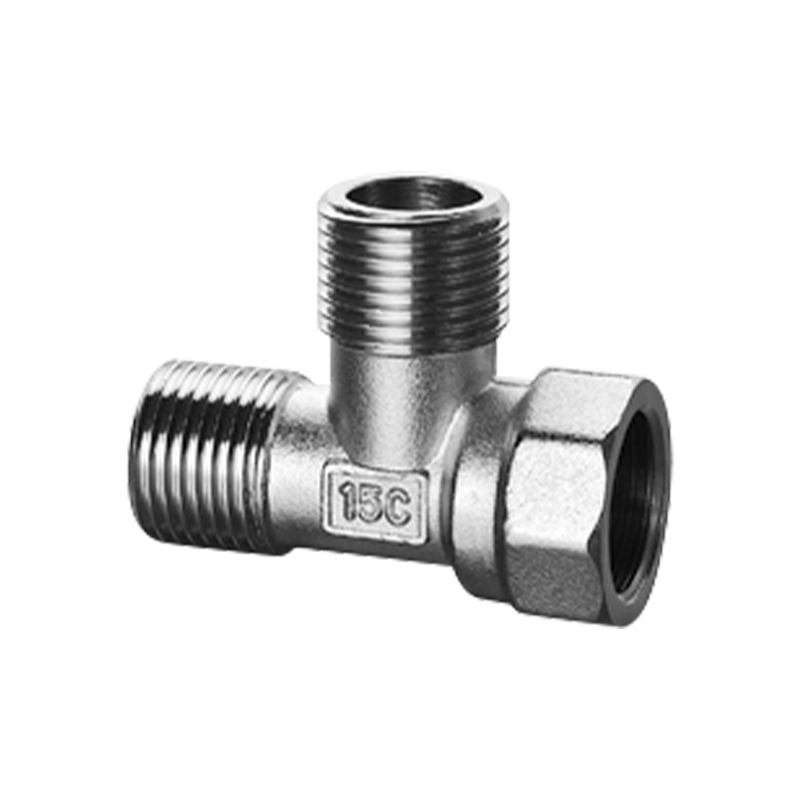
The internal and external wire tee is a three-way pipe fitting engineered to distribute gas flow between a main pipeline and a branch line. Its name reflects the two different thread arrangements incorporated into the fitting. One connection uses internal threading, while another uses external threading, enabling the tee to interface with pipe segments or accessories that have corresponding opposite threads. The third connection completes the branch arrangement and allows the fitting to be integrated into the broader pipeline system.
The product is identified by the model number RBG-IT15X15-GB/T 26002 and is specified as DN15. Its product numbering reference is ZLP-019. The fitting belongs to the category of stainless steel corrugated hose fittings for gas transmission, making it suitable for systems where a flexible metal hose, rigid pipe, valve, regulator, or other gas-line component must be connected in a reliable and compact manner.
Although a tee appears simple in shape, its performance depends on many engineering details. Thread accuracy, material quality, wall thickness, surface condition, dimensional consistency, and sealing compatibility all influence the final reliability of a gas connection. A well-designed tee must maintain its mechanical integrity while exposed to pressure, vibration, temperature changes, installation forces, and possible corrosive environmental conditions.
The internal and external wire tee addresses these requirements through a robust metal construction and a connection design intended to support secure assembly. When used with suitable sealing methods and compatible pipeline components, it can help create a tight, stable, and serviceable branch connection.
2. The Role of a Tee in Gas Pipeline Design
A tee fitting is used whenever a pipeline must divide or combine flow. In a gas distribution system, a main line may supply several appliances, pressure-control devices, building zones, equipment units, or process stations. Rather than using multiple directional fittings to construct a branch, a tee provides a direct three-way connection that can reduce the number of joints and simplify the overall layout.
Every additional joint in a gas pipeline represents another point that must be assembled correctly, inspected, and maintained. A suitable tee can reduce unnecessary connections and create a cleaner routing arrangement. This may decrease installation time and make future inspection easier. It can also support a more compact pipeline design in equipment rooms, utility cabinets, gas meter assemblies, and other areas where available space is restricted.
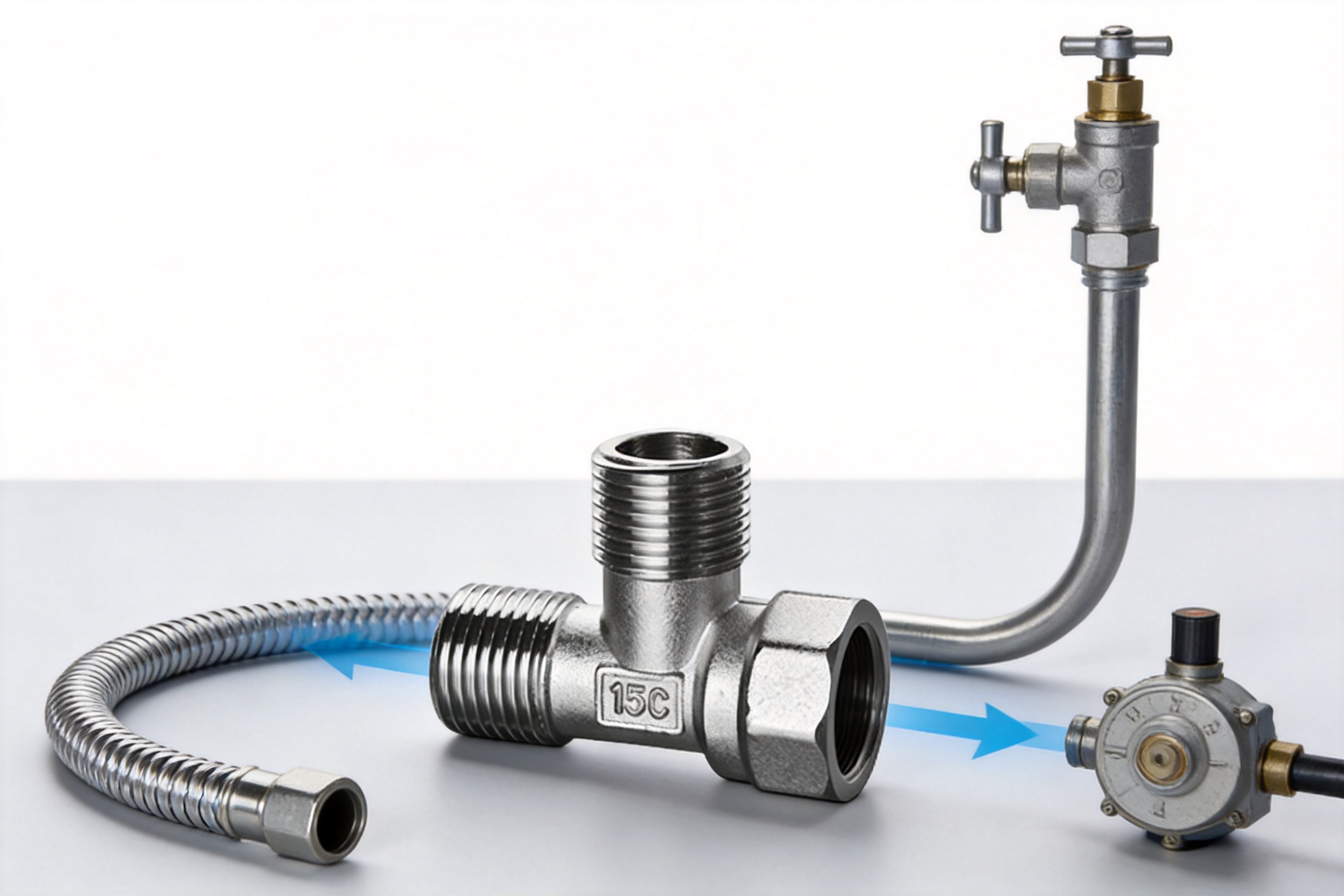
In flexible gas systems, the tee is often installed between corrugated stainless steel hoses and other threaded components. The hose provides movement tolerance and installation flexibility, while the tee creates a branch point. This combination can be useful where the pipeline must accommodate building movement, equipment vibration, alignment differences, or irregular routing.
In industrial systems, tees may be used around burners, boilers, gas skids, pressure regulators, control panels, laboratory equipment, and production machinery. The fitting must be selected according to the pressure, temperature, gas medium, connection standard, and dimensional requirements of the specific system. The DN15 specification is intended for a nominal 15-millimeter pipeline connection and should be matched with compatible pipe and fitting dimensions.
3. Internal and External Thread Configuration
The most important functional feature of this product is its combination of internal and external threads. An internal thread, sometimes called a female thread, is formed inside a fitting opening. It is designed to receive a component with an external thread. An external thread, sometimes called a male thread, is formed on the outside of a fitting end and is designed to enter a component with an internal thread.
By incorporating both arrangements, the tee provides greater connection flexibility than a fitting with only one thread type. Installers can connect different types of pipeline components with fewer transition pieces. This can help reduce the number of adapters required in the system and may lower the risk associated with unnecessary intermediate joints.
The dual-thread design also supports more efficient orientation of connected components. In many installations, the direction of a valve, hose, or branch line must be adjusted to match the available space. A fitting with carefully positioned internal and external connections can make it easier to achieve the required routing without excessive bending or twisting of the hose.
Threaded connections must be assembled with care. Threads should be clean, undamaged, correctly aligned, and compatible with the mating component. Cross-threading, over-tightening, contamination, or the use of unsuitable sealing materials can impair performance regardless of the quality of the tee itself. For gas applications, installation should follow applicable technical standards, project specifications, and professional safety procedures.
Connection Flexibility
Connection flexibility is one of the clearest advantages of the internal and external wire tee. A conventional tee may require separate male-to-male, female-to-female, or other adapters when the connected components have incompatible thread arrangements. Each adapter adds cost, assembly time, length, and another possible leakage point. The dual-thread tee can simplify the connection chain by accommodating different component interfaces directly.
This flexibility is valuable during replacement and repair work. Existing gas installations may contain components from different production periods or suppliers. Their connection orientations may not be identical, and the available space may not permit a complete redesign. A versatile tee can help maintenance personnel adapt the new branch connection to the existing pipe layout while minimizing modifications to the rest of the system.
Compact Arrangement
A tee with integrated connection functions can occupy less space than a combination of several fittings. Compactness is useful in gas meter boxes, wall cavities, equipment enclosures, cabinet assemblies, and plant utility areas. A shorter connection path can also reduce the amount of rigid pipe required between components, helping designers create a more orderly installation.
Compact design does not eliminate the need for proper clearance. The completed connection must still provide enough room for tightening, inspection, leak testing, and future maintenance. Nevertheless, the product can support a more efficient use of installation space when compared with a multi-adapter assembly.
4. Material and Structural Advantages
The internal and external wire tee is manufactured from high-strength, corrosion-resistant metal materials suitable for gas pipeline service. Stainless steel is widely used in corrugated hose fittings because it offers a useful combination of strength, corrosion resistance, durability, and clean surface characteristics. These properties are important where the fitting may be exposed to moisture, condensation, temperature variation, construction dust, cleaning chemicals, or other environmental influences.
Corrosion resistance helps preserve the external surface and the thread geometry over a long service period. If threads become heavily corroded, assembly and disassembly may become difficult, and sealing performance may be compromised. A corrosion-resistant material can help the fitting maintain its functional dimensions and reduce the need for premature replacement.
High mechanical strength is also important. During installation, the fitting may experience tightening torque, handling impact, alignment forces, and localized stress. During operation, the pipeline can be exposed to pressure pulsation, vibration, thermal expansion, and movement caused by connected equipment. A structurally sound tee is better able to withstand these conditions when correctly selected and installed.
The fitting’s body must provide sufficient support around the threaded sections and branch junction. The transition between the main passage and the branch must be formed accurately so that the component remains stable under pressure. The internal passage should also be manufactured with suitable dimensional control to support consistent flow and avoid unnecessary restrictions.
Resistance to Temperature Variation
Gas pipelines may operate in environments with substantial temperature changes. Residential systems can experience seasonal temperature variation, while industrial installations may be located near furnaces, boilers, burners, compressors, or other heat-producing equipment. Temperature changes cause materials to expand and contract. They may also influence the behavior of sealing materials and connected hoses.
A metal tee with suitable strength and thermal stability can help maintain connection integrity during these cycles. Its performance still depends on system design and correct installation, but the material’s resistance to temperature variation provides an important foundation for long-term service.
Resistance to Pressure Variation
Gas pressure may change during start-up, shutdown, regulation, demand fluctuations, or equipment operation. The tee must be appropriate for the pressure class and service conditions of the pipeline. The product’s strong metal construction is intended to support reliable operation in gas transmission applications where pressure stability and leak prevention are critical.
Pressure capability should always be verified against the product documentation and the requirements of the actual installation. A fitting should never be used outside its rated conditions. System designers should consider operating pressure, possible surge conditions, temperature, gas type, connection method, and relevant national or regional regulations.
Internal and external wire tee
5. Advantages Compared with Less Adaptable Alternatives
The internal and external wire tee can provide several practical advantages over basic tees, poorly matched fittings, and multi-adapter assemblies. These advantages are not based only on the shape of the component. They result from the combination of thread versatility, material selection, manufacturing control, and suitability for flexible gas pipeline systems.
Fewer Intermediate Adapters
A tee with only internal threads or only external threads may require additional adapters to connect with components using the opposite configuration. An adapter-based arrangement can function correctly when properly selected, but it introduces more parts into the system. More parts usually mean more assembly operations, more dimensional interfaces, and more opportunities for incorrect installation.
The internal and external wire tee can reduce this complexity. By combining different thread arrangements in one fitting, it can create a more direct connection between the pipeline and the branch component. This may reduce material consumption and help improve installation productivity.
Lower Potential Leakage Risk
Every threaded joint must be sealed and checked. Reducing the number of threaded interfaces can reduce the total number of locations that require sealing and inspection. This does not mean that the tee is automatically leak-proof under every condition. Proper thread matching, sealing technique, torque control, and testing remain essential. However, a simpler connection arrangement can make it easier to manage these requirements.
Improved Maintenance Efficiency
Gas systems require periodic inspection and may eventually need component replacement. A tee that offers flexible connection options can simplify the removal and replacement of branch components. Maintenance personnel may be able to disconnect the affected section without disturbing a larger portion of the pipeline.
The corrosion-resistant construction also supports serviceability. Threads that remain in good condition are easier to inspect and reuse when permitted by the relevant installation requirements. In some cases, this can reduce downtime and help maintenance teams return equipment to service more quickly.
Better Suitability for Compact Installations
Multi-fitting assemblies can become long, heavy, and difficult to position. A compact tee helps reduce the overall envelope of the branch arrangement. This is especially valuable in gas meter cabinets, wall-mounted equipment, utility risers, and industrial panels where every millimeter of space may matter.
Consistent Appearance and System Organization
A professionally manufactured metal tee gives the completed pipeline a clean and organized appearance. A compact, consistent fitting arrangement can make the flow path easier to understand during inspection. In commercial and industrial facilities, orderly pipework can also support housekeeping, labeling, and preventive maintenance programs.
6. Manufacturing Capabilities and Process Strengths
The quality of a pipe fitting begins long before final assembly. It depends on material selection, forming, machining, welding where applicable, heat treatment, surface finishing, dimensional inspection, pressure testing, packaging, and production traceability. The manufacturer of this product operates an integrated research, development, manufacturing, and processing organization focused on energy equipment and related pipeline products.
The company’s production capabilities include metal hoses, natural gas pipelines, plumbing fittings, sanitary ware, valves, plastic products, and hardware. This broad product scope provides experience across several related manufacturing disciplines. It also supports a deeper understanding of how individual fittings interact with hoses, valves, regulators, and other pipeline components in complete systems.
The manufacturing site covers approximately 40 acres and includes a factory building of about 30,000 square meters. The facility has 30 welding and forming production lines, providing substantial capacity for metal forming and related component production. The availability of multiple production lines can support product specialization, process organization, and more efficient scheduling for different product families.
Welding and Forming Expertise
Welding and forming are central processes in the production of metal hoses and their fittings. Forming operations influence the shape, dimensional accuracy, and structural consistency of the component. Welding quality affects the integrity of joints, especially where components are connected permanently or where the assembly must withstand pressure and vibration.
Experienced production teams can control key parameters such as forming force, alignment, heat input, welding speed, shielding conditions, and post-weld inspection. Consistent control helps reduce defects such as incomplete fusion, excessive distortion, surface cracking, dimensional deviation, or irregular transitions. The specific process used for a product depends on its design and applicable standards, but the presence of dedicated welding and forming capacity is a significant manufacturing strength.
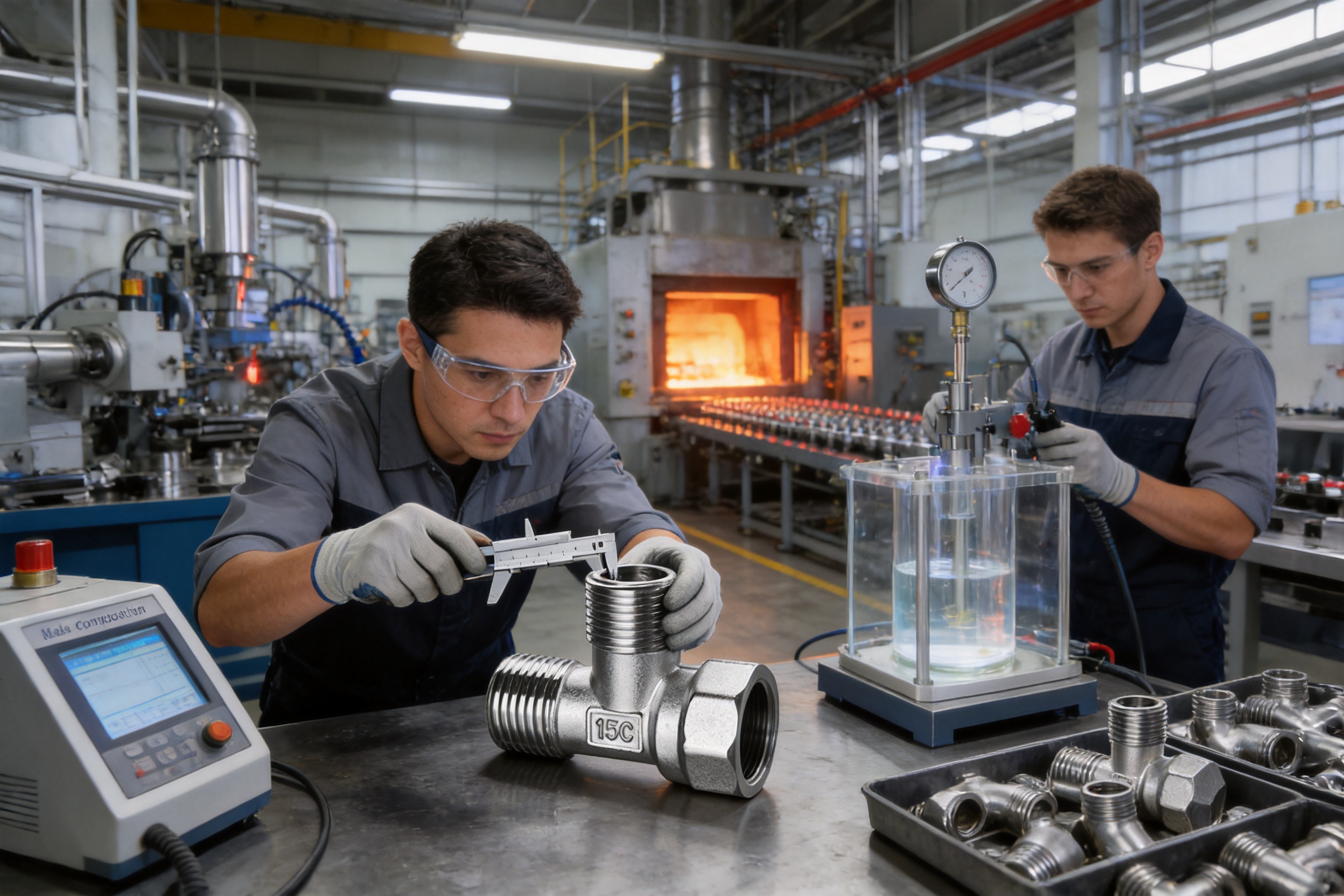
Specialized Furnace Equipment
The facility also includes two uninterrupted solid melting hydrogen furnace production lines. Specialized furnace equipment can support controlled material processing and help improve consistency in relevant metal production operations. Controlled thermal processing is important because material structure can influence strength, ductility, corrosion behavior, and dimensional stability.
When thermal processes are managed under controlled conditions, manufacturers can better maintain repeatability between production batches. This is particularly valuable for fittings that must maintain accurate thread dimensions and stable mechanical properties. Furnace operations must be combined with appropriate material testing and process monitoring to deliver dependable results.
Material Analysis
The company uses direct-reading spectrometers for metal material analysis. A spectrometer can help identify and verify the chemical composition of metallic raw materials. Material verification is important because the performance of stainless steel and other alloys depends strongly on their elemental composition.
By checking incoming materials and monitoring production inputs, a manufacturer can reduce the risk of using an incorrect alloy or material grade. Chemical composition analysis can support purchasing control, production traceability, and quality documentation. It also helps align the finished fitting with the intended corrosion resistance and mechanical performance requirements.
Flow and Tightness Testing
Flow tightness testers are used to evaluate whether components maintain the required sealing performance. For gas fittings, tightness testing is especially important because even a small leak can create a safety concern, cause product loss, or result in system failure. Testing equipment provides a more reliable evaluation than visual inspection alone.
Depending on the product specification and testing procedure, a fitting may be assessed under controlled pressure or with another approved method. Testing helps identify problems related to thread damage, porosity, forming defects, welding irregularities, surface imperfections, or sealing-interface inconsistency.
The combination of material analysis and tightness testing is valuable because it addresses both the internal quality of the metal and the functional performance of the finished product. A fitting may have acceptable appearance but still fail a tightness test, while a leak-free fitting may not meet the intended material specification. Comprehensive quality control must consider both aspects.
7. Quality Management and Certification Background
The manufacturer states that it strictly implements the ISO9000:2008 quality management system. A quality management framework helps organize production procedures, inspection responsibilities, corrective actions, documentation, and customer service. Although certification and management systems do not replace product-specific testing, they provide a structured basis for maintaining process consistency.
The company also holds a Special Equipment Manufacturing License of the People’s Republic of China for pressure pipelines and has EU CE certification testing reports. These credentials and reports indicate experience with regulated pressure-related products and international conformity requirements. Buyers should request the latest product-specific certificates, test reports, declarations, and technical documentation when required for a particular project.
The company is also a member of the China Urban Gas Association. Participation in an industry association can support awareness of market developments, technical practices, and application requirements in the urban gas sector. For customers purchasing gas fittings, sector experience is valuable because gas pipeline products must be designed and manufactured with safety, reliability, and regulatory compliance in mind.
Process-Based Quality Control
For a fitting such as the internal and external wire tee, quality control should cover the full production chain. Incoming raw materials should be identified and verified. Forming and machining operations should be monitored for dimensional accuracy. Threads should be checked for pitch, profile, diameter, depth, surface condition, and compatibility with the specified standard.
Finished fittings should be inspected for cracks, burrs, distortion, contamination, and other defects. The sealing areas should be clean and properly formed. Functional testing should be performed according to the relevant product requirements. Inspection records and batch information should be maintained to support traceability and customer communication.
A manufacturer with in-house production capabilities and testing equipment can coordinate these activities more effectively than a trading operation that relies entirely on unrelated subcontractors. Integrated production can shorten communication channels between design, process engineering, quality control, and customer service.
8. Product Specification and Selection Reference
The available product information identifies one standard configuration of the internal and external wire tee. The following table summarizes the supplied specification.
| Item | Specification |
|---|---|
| Product numbering | ZLP-019 |
| Model number | RBG-IT15X15-GB/T 26002 |
| Product name | Internal and external wire tee |
| Nominal size | DN15 |
| Product category | Stainless steel corrugated hose fittings for gas transmission |
| Primary function | Three-way gas flow distribution and threaded connection |
| Connection arrangement | Internal and external threaded interfaces |
| Typical application areas | Residential, commercial, and industrial gas systems |
When selecting this tee, purchasers should confirm the required thread standard, nominal size, pressure rating, operating temperature, gas medium, installation orientation, and sealing method. The DN15 designation should not be treated as a substitute for checking the actual thread dimensions and mating component specifications.
It is also important to verify whether the selected product is intended for a particular national code, regional standard, or project specification. The model reference includes GB/T 26002, but the final installation must comply with the standards and regulations applicable at the project location.
Compatibility with Corrugated Hose
Stainless steel corrugated hose systems offer flexibility that rigid pipe cannot provide in every installation. They can help compensate for alignment differences and simplify routing around obstacles. The tee acts as a branch connector within that flexible system, but the hose and fitting must be compatible in size, connection type, pressure capability, and installation procedure.
The hose should not be twisted, excessively bent, stretched, or used to support an unintended load. The tee should be positioned so that connected hoses approach their ports naturally. Good alignment reduces stress on the threads and sealing interfaces and helps extend the service life of the complete assembly.
Compatibility with Valves and Regulators
Gas systems frequently connect tees to valves, regulators, meters, and control devices. These components may have different thread orientations or installation requirements. The internal and external wire tee can make the transition more convenient, but the installer must confirm that the component connection is mechanically and functionally suitable.
Where a valve or regulator requires a particular flow direction, the branch layout must be planned carefully. The tee should be installed in an orientation that supports correct flow direction, access to operating controls, and adequate room for inspection. The fitting should not be used to force a device into an unsuitable angle or position.
9. Installation Guidance
Professional installation is essential for safe gas pipeline performance. Before assembly, all components should be checked for damage, contamination, incorrect dimensions, and thread incompatibility. Protective caps should remain in place until the fitting is ready to be installed. Foreign particles in the threads or sealing areas can interfere with assembly and may damage the connection.
The mating parts should be aligned by hand before tools are used. If the threads do not engage smoothly, the connection should be removed and inspected rather than forced. Cross-threading can permanently damage the fitting and create an unreliable joint. Tools should be applied only to the designated wrenching surfaces, and the fitting should not be gripped in a way that deforms the body or threaded section.
The correct sealing material and method must be selected for the thread design and gas service. Some threaded systems seal on the thread itself, while others seal through a gasket, washer, cone, or dedicated sealing face. Sealants should be compatible with the gas, the metal material, the operating temperature, and the applicable regulations. Excess sealing material should not be allowed to enter the gas passage.
After installation, the system should be inspected and tested according to the relevant safety procedures. Leak testing should be performed before the pipeline is placed into service. The test method, pressure, duration, and acceptance criteria should be determined by qualified personnel and the applicable code or project documentation.
Once the system is operational, the tee and surrounding connections should be included in routine inspection programs. Signs of corrosion, movement, vibration, mechanical damage, leakage, or thread deterioration should be investigated promptly. Any modification to the pipeline should be carried out by authorized professionals.
Installation Errors to Avoid
Common errors include mixing incompatible thread standards, using the wrong nominal size, tightening without proper alignment, applying excessive torque, using an unsuitable sealant, and bending a connected hose too sharply near the fitting. Another frequent problem is allowing the tee to carry the weight of unsupported equipment or pipework.
Installers should also avoid using a wrench on a non-wrenching surface, striking the fitting during assembly, or attempting to repair damaged threads with improvised methods. If a fitting has been visibly deformed or damaged, replacement is generally safer than continued use.
10. Application Areas
Residential Gas Systems
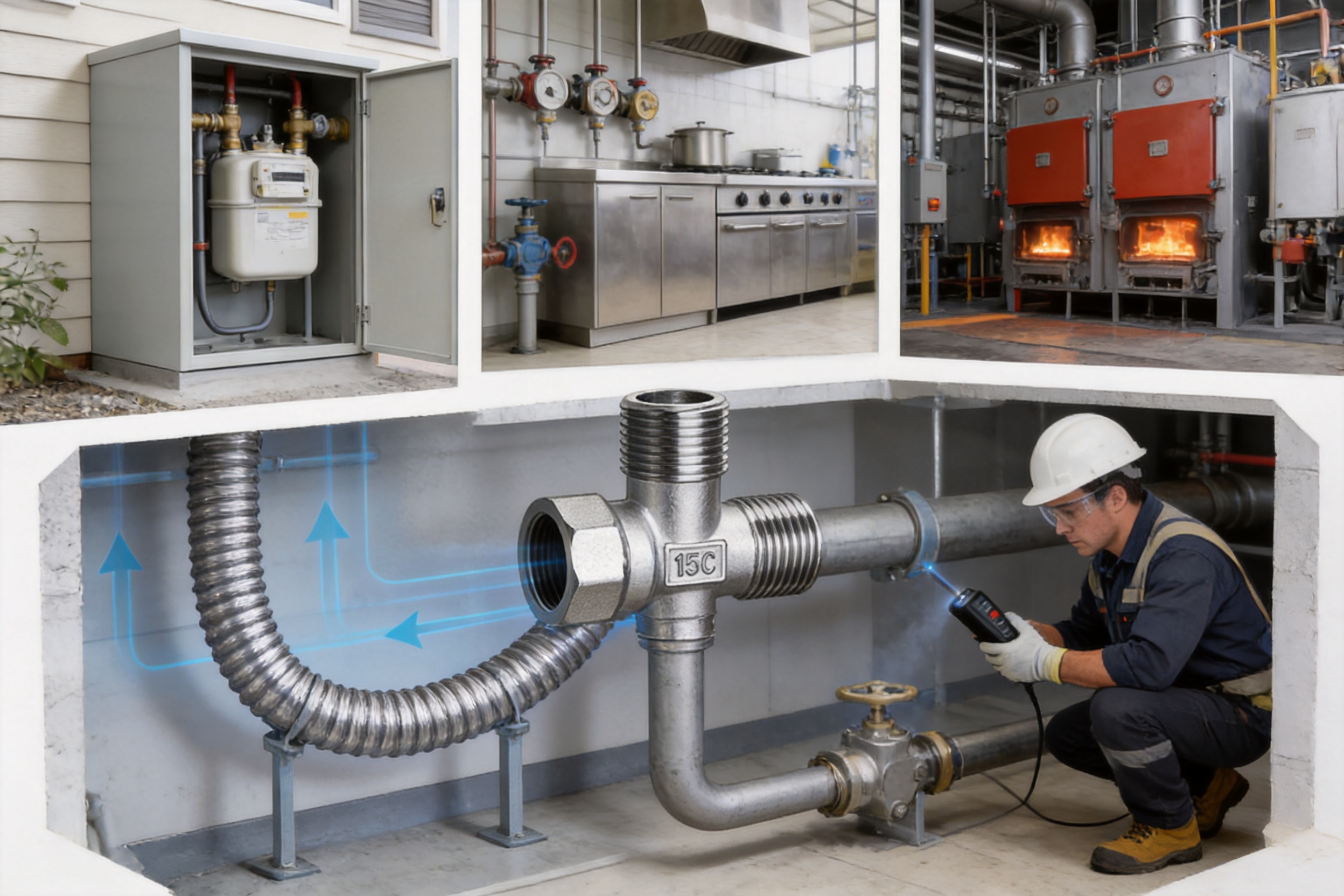
In residential buildings, a tee may be used to distribute gas toward appliances, meters, regulators, or individual branch lines. The compact form of the fitting is helpful in kitchens, utility spaces, service cabinets, and other locations where pipework must remain organized and unobtrusive.
Residential gas systems require particular attention to sealing and inspection because they are located near occupied spaces. The corrosion-resistant metal construction can support long-term service, while the dual-thread arrangement may simplify connections to existing valves and flexible hose assemblies.
Commercial Buildings
Restaurants, hotels, office buildings, retail facilities, and institutional properties may contain multiple gas-consuming appliances or distributed equipment rooms. A tee can support branch connections from a main gas line while helping keep the installation compact and accessible.
Commercial systems often require regular maintenance and equipment replacement. A fitting that allows different connection arrangements can reduce the need for extensive pipeline modifications when appliances or control components are changed.
Industrial Facilities
Industrial applications may include burners, ovens, boilers, production lines, heating systems, laboratories, and process equipment. These environments can expose fittings to vibration, heat, dust, chemicals, and pressure fluctuations. A high-strength, corrosion-resistant tee is suitable for consideration in such systems when its technical ratings match the operating requirements.
Industrial buyers may also value consistent batch production, material verification, testing records, and customization support. Because industrial pipelines are often integrated into larger systems, the ability to coordinate fittings, hoses, valves, and related products through one experienced supplier can simplify procurement and technical communication.
Natural Gas Distribution Assemblies
The product is designed for gas flow distribution and is associated with natural gas pipeline and metal hose applications. It can be integrated into assemblies that connect a supply line to a branch line, pressure-control equipment, or end-use devices. The final configuration must be designed according to the gas type, pressure level, applicable safety code, and required inspection procedure.
11. Custom Manufacturing and OEM/ODM Support
Pipeline projects do not always use one universal fitting configuration. Customers may require different sizes, thread standards, surface finishes, body shapes, connection lengths, markings, packaging, or inspection documents. A manufacturer with research, design, production, and processing capabilities can be better positioned to support these requirements.
The company describes itself as an OEM and ODM supplier of metal hoses, corrugated hoses, pipe fittings, and related precision-engineered products. OEM production generally involves manufacturing according to customer drawings, specifications, or branding requirements. ODM support may include assistance with product design, development, process selection, and production optimization.
For buyers, this capability can be valuable when developing a new gas equipment assembly or adapting an existing product to local requirements. Engineering discussions may cover thread geometry, nominal diameter, body dimensions, material selection, surface treatment, sealing interfaces, pressure testing, labeling, and packaging.
Successful customization requires clear technical documentation. Customers should provide drawings, tolerances, application conditions, expected annual volume, required certifications, inspection standards, and delivery requirements. The supplier can then evaluate manufacturing feasibility, tooling needs, test procedures, and production lead time.
Benefits of an Integrated Supplier
An integrated supplier can coordinate design and manufacturing decisions more efficiently. For example, a change in fitting geometry may affect forming operations, machining tools, welding procedures, inspection fixtures, and packaging. When these activities are managed within a connected organization, engineering feedback can move more quickly between departments.
Integrated production can also support more consistent product families. A customer purchasing a corrugated hose, tee, valve connection, or related fitting from the same source may benefit from better dimensional coordination and fewer compatibility questions. This does not remove the need for independent verification, but it can simplify supplier management.
12. Company Strengths Supporting Product Reliability
The manufacturer’s main strengths include industry experience, broad product coverage, dedicated production infrastructure, material analysis capability, tightness testing equipment, quality management procedures, and regulatory experience in pressure pipeline products.
Its location in Yuyao, Zhejiang, places the factory within a major manufacturing region with access to industrial supply chains, engineering resources, logistics networks, and metal-processing expertise. The company address is No. 369 Shunyu West Road, Yangming Street, Yuyao City, Zhejiang, China.
The company maintains a strong research, development, design, and production team. This combination is important for fittings because product performance depends not only on raw materials but also on geometry, process parameters, quality inspection, and application knowledge. A supplier that understands the complete system can provide more useful technical assistance than one that sells isolated components without considering their installation environment.
The company also emphasizes pre-sales and after-sales service. Pre-sales support may include product selection, drawings, application consultation, sample coordination, and quotation preparation. After-sales support may involve installation guidance, technical communication, quality feedback, replacement coordination, and documentation assistance. These services are particularly important for gas pipeline components, where incorrect selection can create safety and operational problems.
13. Purchasing Considerations for Distributors and Project Contractors
Distributors and contractors should evaluate more than unit price when purchasing gas tees. A low-cost fitting may become expensive if it causes installation delays, leakage problems, premature corrosion, or compatibility issues. Total value includes product quality, dimensional consistency, delivery reliability, documentation, technical support, and after-sales responsiveness.
Buyers should first confirm the required size and connection type. For the product discussed in this article, the available specification is DN15 with model reference RBG-IT15X15-GB/T 26002. The buyer should confirm that the mating hose, valve, regulator, or pipe uses the corresponding thread standard and dimension.
Next, the operating environment should be reviewed. Important factors include gas composition, operating pressure, maximum and minimum temperature, exposure to moisture or chemicals, vibration, installation location, and expected service life. These conditions help determine whether the selected material and design are suitable.
Documentation should also be considered. Depending on the project, purchasers may require material certificates, product inspection records, pressure or tightness test results, conformity declarations, quality system information, and traceability information. The specific documents should be agreed before mass production or shipment.
For repeated procurement, buyers may benefit from establishing an approved product specification. This can include dimensional drawings, inspection tolerances, packaging requirements, marking rules, sampling plans, and acceptance criteria. A clear specification reduces misunderstandings and supports consistent quality across multiple orders.
14. Maintenance and Service-Life Management
Proper maintenance helps preserve the performance of any gas pipeline fitting. The tee should be visually inspected at intervals appropriate for the system. Inspection may include checking for surface corrosion, discoloration, mechanical damage, unusual movement, vibration, loose connections, and evidence of gas leakage.
Connections should not be repeatedly tightened without identifying the reason for looseness or leakage. Repeated adjustment can damage threads or sealing surfaces. If leakage is suspected, the system should be isolated and examined by qualified personnel using an approved test method.
Environmental cleanliness also matters. Dirt, moisture, salt deposits, or chemical residues can accelerate surface degradation. In exposed installations, appropriate protective measures may be considered, provided they do not conceal defects or prevent inspection.
Where hoses are connected to the tee, the hose should be checked for excessive bending, twisting, abrasion, flattening, or contact with sharp edges. A fitting may remain sound while a connected hose has become damaged due to poor routing or external stress. Maintenance should therefore evaluate the complete assembly rather than the tee alone.
Service life depends on many factors, including material, pressure, temperature, gas medium, vibration, installation quality, and maintenance frequency. No fitting should be assumed to have unlimited life. Replacement intervals and inspection programs should follow the requirements of the system designer, equipment manufacturer, applicable standards, and local authorities.
15. Safety and Compliance Considerations
Gas pipeline work should be performed only by qualified personnel familiar with the relevant safety requirements. Before installation or maintenance, the gas supply must be controlled according to the approved procedure. Ignition sources, ventilation, pressure release, and leak testing must be managed appropriately.
The tee should be used only within its intended application and verified operating range. Product selection should account for the actual gas medium and not rely solely on nominal size. Natural gas, liquefied petroleum gas, manufactured gas, and other gases may have different chemical and operational characteristics.
Compliance requirements vary by country, region, building type, and application. A project may require products certified to specific standards or installed by licensed professionals. The manufacturer’s available quality and certification background can support technical evaluation, but the project owner, designer, contractor, and approving authority remain responsible for confirming final compliance.
Pressure testing and leak testing are essential before commissioning. Testing should be documented when required. If a pipeline has been modified, repaired, or extended, the affected portion should be evaluated according to the applicable procedure before returning to service.
16. Frequently Asked Questions
Q1: What is an internal and external wire tee?
An internal and external wire tee is a three-way gas pipeline fitting that includes both internal and external threaded connection arrangements. It is used to divide gas flow and connect pipeline sections or accessories with different thread orientations.
Q2: What is the listed size of this product?
The listed specification is DN15. The associated model number is RBG-IT15X15-GB/T 26002, and the product numbering reference is ZLP-019.
Q3: What materials are used for the tee?
The product is described as being made from high-strength, corrosion-resistant materials and is categorized as a stainless steel corrugated hose fitting for gas transmission. Customers should confirm the exact material grade and required certificates for their project.
Q4: Where can this tee be used?
It can be considered for residential, commercial, and industrial gas pipeline systems. Typical uses include branch connections for gas appliances, regulators, valves, meters, burners, boilers, and industrial equipment, provided that the product ratings and connection standards match the application.
Q5: What is the main advantage of the dual-thread design?
The dual-thread design provides greater connection flexibility. It can reduce the need for additional adapters when different pipeline components use internal and external thread arrangements. This may simplify installation, save space, and reduce the number of threaded joints requiring sealing and inspection.
Q6: Does the tee eliminate the need for leak testing?
No. Even a well-manufactured fitting must be installed correctly and tested after assembly. Leak testing should be performed using an approved method and according to the applicable safety code, project specification, or professional procedure.
Q7: Can the tee be used with corrugated stainless steel hose?
It is categorized as a stainless steel corrugated hose fitting for gas transmission and is intended for use in related gas pipeline systems. The hose size, thread type, pressure rating, temperature range, and installation method must be verified for compatibility.
Q8: What manufacturing capabilities support the product?
The manufacturer operates welding and forming production lines, specialized hydrogen furnace lines, metal material analysis equipment, and flow tightness testing equipment. These capabilities support material verification, controlled processing, dimensional production, and functional inspection.
Q9: Does the manufacturer provide OEM or ODM services?
The company provides OEM and ODM production for metal hoses, corrugated hoses, pipe fittings, and related precision-engineered products. Custom projects should be based on confirmed drawings, materials, dimensions, testing requirements, certifications, and packaging instructions.
Q10: What should buyers confirm before ordering?
Buyers should confirm nominal size, thread standard, material grade, pressure and temperature requirements, gas medium, quantity, inspection documents, marking, packaging, delivery schedule, and any project-specific certification requirements.
Q11: How should the tee be maintained?
The fitting and surrounding pipeline should be inspected for corrosion, leakage, mechanical damage, vibration, loose connections, and hose stress. Any suspected leak or damaged component should be addressed by qualified personnel, and the system should be isolated when necessary.
Q12: Why is material analysis important?
Material analysis helps verify the chemical composition of the metal used in production. Correct composition supports the intended strength, corrosion resistance, thermal performance, and durability of the fitting.
17. Conclusion
The internal and external wire tee is a practical component for gas flow distribution and branch connection in modern pipeline systems. Its combination of internal and external threads gives installers greater flexibility when connecting corrugated hoses, pipes, valves, regulators, meters, and other gas-line components. By reducing the need for multiple adapters, the fitting can support a more compact and efficient installation with fewer threaded interfaces to assemble and inspect.
Its high-strength, corrosion-resistant construction is intended to provide dependable performance under pressure variation, temperature change, and demanding service conditions. The product is identified as model RBG-IT15X15-GB/T 26002, specification DN15, and product number ZLP-019.
The manufacturer’s strengths extend beyond the individual fitting. Its integrated research, design, manufacturing, and processing capabilities include extensive welding and forming capacity, specialized furnace production lines, metal composition analysis, and flow tightness testing. Its quality management practices, pressure pipeline manufacturing experience, certification background, and OEM/ODM support provide additional value for distributors, contractors, equipment manufacturers, and industrial project owners.
For the best results, the tee should be selected according to the complete pipeline design and installed by qualified professionals. Thread compatibility, sealing method, pressure rating, temperature range, gas medium, inspection requirements, and local regulations must all be considered. When these factors are properly managed, the internal and external wire tee can serve as a reliable and adaptable connection solution for residential, commercial, and industrial gas systems.
References
1. Product specification information for the internal and external wire tee, model RBG-IT15X15-GB/T 26002, DN15.
2. GB/T 26002, referenced product standard for the listed fitting configuration.
3. ISO 9000 family of quality management system principles and terminology.
4. General technical practices for stainless steel corrugated hose assemblies and threaded gas pipeline fittings.
5. General safety practices for gas pipeline installation, pressure testing, leak detection, and maintenance.
6. Manufacturer information concerning welding and forming production lines, hydrogen furnace production, material analysis, tightness testing, certification background, and OEM/ODM manufacturing services.
7. General engineering principles for threaded pipe connections, branch flow distribution, corrosion-resistant materials, and industrial gas equipment maintenance.