 English
 中文简体
中文简体 Español
 عربى
عربى
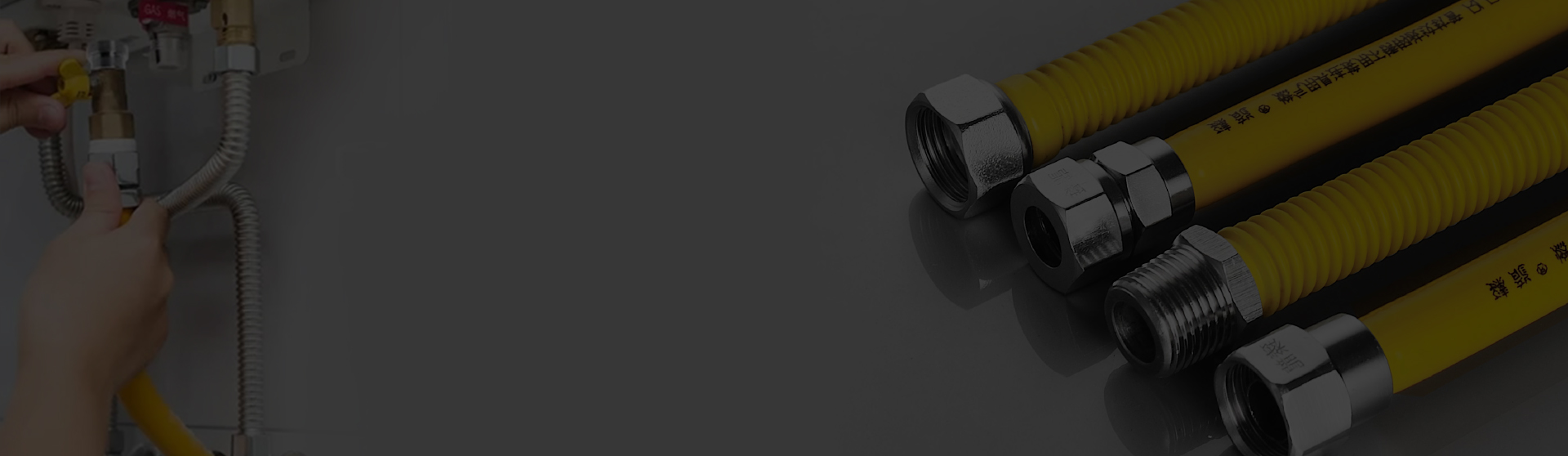

Gas distribution systems depend on many small but essential components. Among them, the tee fitting plays a particularly important role because it allows a pipeline to divide one gas flow into two directions. The external thread tee is designed for this purpose, providing a practical connection point for branching gas lines while supporting the safety, stability, and serviceability required in residential, commercial, and industrial installations.
Although a tee fitting may appear simple, its performance has a direct effect on the reliability of an entire pipeline system. A poorly manufactured fitting can create alignment problems, leakage risks, pressure losses, installation delays, and premature maintenance requirements. By contrast, a well-designed external thread tee provides a secure threaded connection, consistent dimensional accuracy, strong resistance to corrosion and heat, and dependable performance under demanding operating conditions.
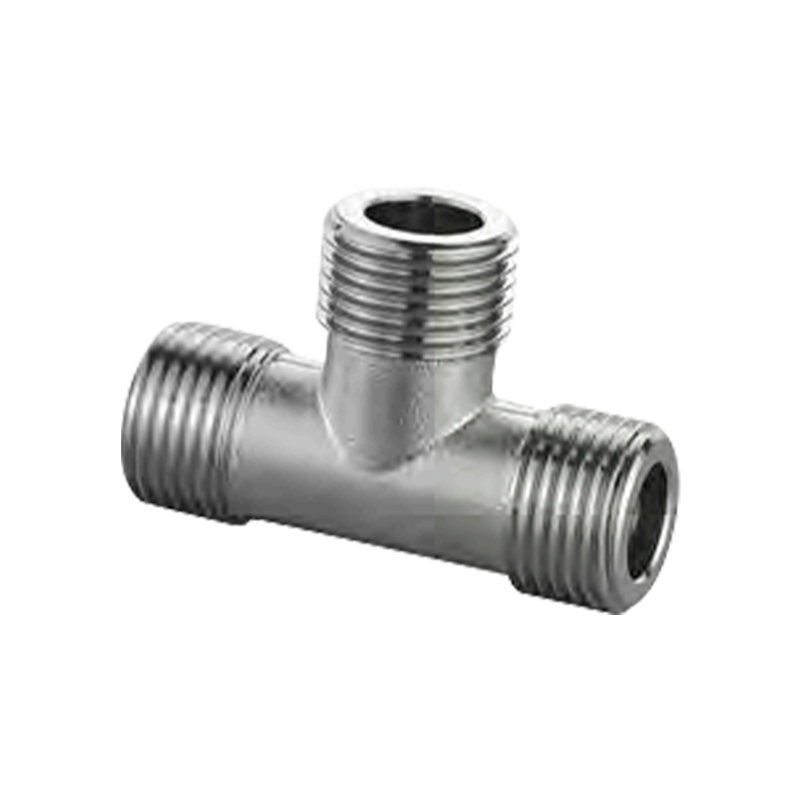
The external thread tee described in this article is a stainless steel corrugated hose fitting intended for gas transmission applications. It is identified by model number RBG-IT15X15-GB/T 26002, product number ZLP-018, and specification DN15. Its external thread configuration makes it suitable for connection with compatible internally threaded components, including valves, adapters, hose assemblies, elbows, and other pipeline fittings.
This article explains the construction, working principle, benefits, applications, installation considerations, quality characteristics, and manufacturing strengths associated with the external thread tee. It also examines why precision production, material selection, controlled welding and forming, testing, and quality management are important when choosing fittings for gas pipeline systems.
External Thread Tee
Content
- 1 What Is an External Thread Tee?
- 2 Role in Gas Distribution Systems
- 3 Key Product Characteristics
- 4 Advantages Compared with Less Specialized Alternatives
- 5 Materials and Performance Considerations
- 6 Manufacturing Process and Quality Strengths
- 7 Precision Features That Influence Performance
- 8 Applications
- 9 Installation Guidance
- 10 Inspection and Maintenance
- 11 Purchasing and Technical Evaluation
- 12 Why Manufacturing Depth Matters to Buyers
- 13 Environmental and Operational Durability
- 14 Safety Considerations
- 15 Quality Comparison with Generic Fittings
- 16 Recommended Use in System Design
- 17 Product Identification
- 18 Q&A
- 18.1 What is the primary purpose of the external thread tee?
- 18.2 What does DN15 mean?
- 18.3 Can the tee be used with any DN15 fitting?
- 18.4 Why are external threads useful?
- 18.5 Is the product suitable for both residential and industrial systems?
- 18.6 What makes stainless steel useful for this application?
- 18.7 Does the tee control gas pressure?
- 18.8 Can the tee support a hose or appliance?
- 18.9 How should a threaded connection be sealed?
- 18.10 What manufacturing equipment supports product quality?
- 18.11 Can customized products be requested?
- 18.12 What should be checked after installation?
- 18.13 How can customers confirm compliance?
- 19 Conclusion
- 20 References
- 21 Product: External Thread Tee
What Is an External Thread Tee?
An external thread tee is a three-port pipe fitting with male threads on its connection ends. The three openings are arranged in a tee-shaped configuration. One port generally serves as the inlet, while the other two ports direct the gas into separate branches. Depending on the design of the complete system, the tee may also be used in reverse, allowing two branch lines to converge into one main line.
The external threads are formed on the outside of the fitting. They engage with internal threads on a compatible female fitting. When correctly matched and tightened, the threaded connection creates a stable mechanical joint. An appropriate sealing method is normally used to help prevent gas leakage and to accommodate the requirements of the applicable installation standard.
For gas applications, the connection must provide more than simple mechanical attachment. It must maintain dimensional consistency, resist deformation, tolerate pressure fluctuations, and remain stable when exposed to temperature changes, vibration, moisture, and corrosive substances. The external thread tee is therefore manufactured as a functional pressure-related component rather than as a basic plumbing accessory.
The DN15 specification indicates a nominal diameter suited to compact gas pipeline assemblies. The exact outside dimensions, thread form, wall thickness, and connection compatibility should always be confirmed against the relevant drawings, standards, and project requirements. Nominal size alone does not replace the need to verify working pressure, temperature range, material grade, and installation conditions.
Role in Gas Distribution Systems
Gas pipeline networks frequently require branch connections. A single supply line may need to serve multiple appliances, equipment units, rooms, production areas, or secondary distribution circuits. The external thread tee makes it possible to create such a branch without using improvised connections or excessive additional components.
In a residential installation, a tee may divide gas from a main supply pipe toward a cooking appliance and a water heater. In a commercial kitchen, it may serve separate groups of cooking equipment. In an industrial facility, it can connect gas to burners, process equipment, testing stations, heating systems, or controlled distribution zones.
A properly designed tee supports organized routing and can make the pipeline easier to inspect. The branch point is clearly defined, and the use of threaded connections can simplify replacement or modification when the system is properly isolated and depressurized. This serviceability is especially useful in systems that may require future expansion or periodic component replacement.
Flow direction and branch arrangement should be considered during system design. Although the tee provides a convenient division point, the complete installation must account for pressure drop, flow demand, pipe length, regulator capacity, shutoff valves, and the characteristics of the gas being transported. The fitting is one part of a complete engineered system and should be selected accordingly.
Key Product Characteristics
External Thread Configuration
The external thread design allows the tee to connect with internally threaded fittings. This arrangement is widely used because it provides a compact joint and permits direct connection to many common pipeline accessories. A correctly produced thread should have a clean profile, consistent pitch, adequate crest and root definition, and sufficient engagement length.
Thread accuracy is critical. If the thread is too loose, the connection may lack mechanical stability or become more difficult to seal. If it is too tight or dimensionally inconsistent, installation may require excessive force and can damage the mating component. Precise thread production helps create a repeatable connection across multiple installations.
Three-Way Branching Structure
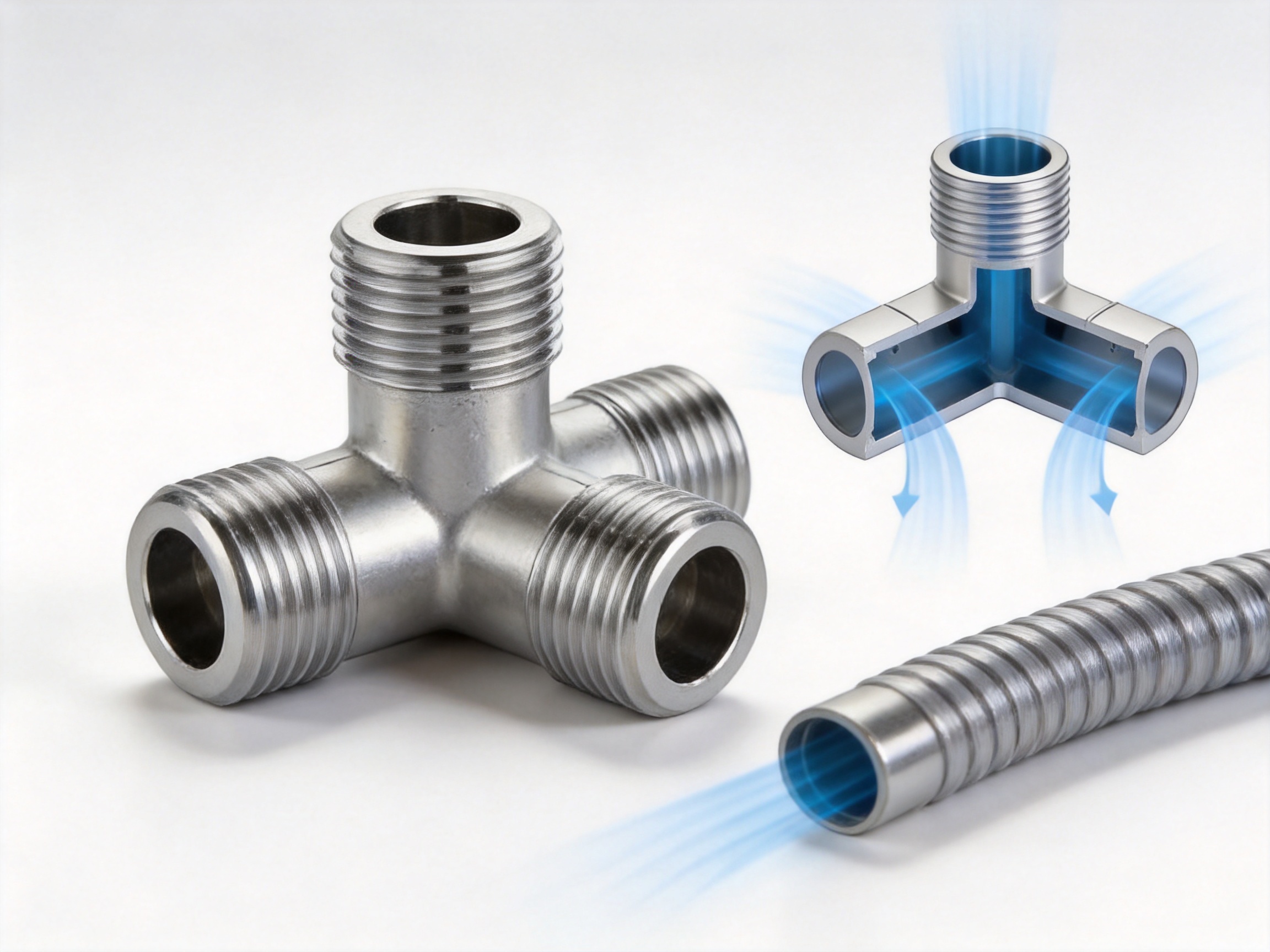
The tee shape provides a central passage with three connected ports. Its internal geometry should support smooth gas movement while avoiding unnecessary restrictions. The junction area must also maintain sufficient strength because it is exposed to internal pressure and mechanical loads from connected pipes or hoses.
Compared with using multiple elbows and adapters to create a branch, a dedicated tee can reduce the number of joints. Fewer joints can simplify installation, reduce potential leakage points, and create a neater pipeline layout. It can also reduce the amount of labor required during assembly.
Corrosion Resistance
Gas pipeline components may encounter humidity, condensation, cleaning chemicals, salts, industrial atmospheres, and other corrosive influences. The corrosion-resistant materials used for this type of fitting help preserve the surface and structural integrity over time.
Corrosion resistance is valuable not only for appearance. Surface deterioration can affect threads, sealing areas, wall thickness, and the cleanliness of the internal passage. A durable material helps the fitting maintain its function through long-term service, provided that the selected material is suitable for the specific gas and environmental conditions.
Heat Resistance
Gas installations may be located near burners, boilers, furnaces, commercial cooking equipment, or other heat-producing machinery. Temperature changes can also occur when gas flow conditions vary or when the surrounding environment changes between day and night.
Heat-resistant construction helps the tee tolerate these conditions without unacceptable softening, cracking, distortion, or loss of dimensional stability. The operating temperature of the complete installation must still remain within the limits of the material, seal, hose, and connected equipment.
Compact and Serviceable Design
The compact form of a tee is useful where installation space is limited. It can be integrated into pipe assemblies without requiring a large clearance area. Its threaded configuration also supports service work because compatible fittings can be removed and replaced using appropriate tools and procedures.
Serviceability is especially important in gas systems. Inspection, pressure testing, maintenance, and replacement must be carried out in a controlled manner. A standardized fitting with consistent dimensions makes these tasks more predictable for installers and maintenance personnel.
Advantages Compared with Less Specialized Alternatives
Reduced Joint Complexity
One of the main advantages of a purpose-built tee is that it provides branching in a single fitting. An alternative approach may involve a series of straight connectors, elbows, reducers, and adapters. Each additional joint increases assembly time and introduces another point that must be correctly sealed and inspected.
By integrating the branch into one component, the external thread tee can reduce the number of connections needed for a given layout. This may help lower the probability of installation errors, shorten assembly time, and improve the overall appearance of the pipework.
Reliable Mechanical Engagement
External threads provide positive mechanical engagement with internal threads. When the mating parts are properly selected and installed, the connection resists separation and maintains alignment. This is particularly useful where connected hoses or pipes may be exposed to vibration, movement, or minor mechanical loading.
The fitting should not be used to compensate for unsupported pipework. Pipes and hoses must be adequately supported, and bending forces should not be transferred directly into the tee. Nevertheless, a precision threaded connection offers a stronger and more dependable starting point for the complete assembly than a loosely fitted or improvised branch.
Better Adaptability
A threaded tee can connect to a range of compatible components. Depending on the thread standard and system design, it may be used with valves, female adapters, flexible hose assemblies, pressure-control devices, or other fittings. This adaptability makes it suitable for both new installations and repair work.
The model reference includes GB/T 26002, which indicates that applicable Chinese standard requirements should be considered when evaluating the product. Projects in other regions may require additional verification against local gas installation codes, thread standards, pressure classifications, and certification requirements.
Long-Term Material Performance
Compared with fittings made from less corrosion-resistant materials, a suitable stainless steel construction can offer improved durability in humid or demanding environments. This can be especially beneficial where the fitting is exposed to condensation or where access for replacement is difficult.
Material performance depends on the specific stainless steel grade, surface condition, gas composition, temperature, and surrounding environment. Buyers should request detailed material information when a project requires a particular alloy, chemical compatibility, or documentation package.
Consistent Production Quality
A tee manufactured through controlled forming, welding, machining, inspection, and testing is more likely to deliver consistent results than a component made through uncontrolled or purely manual processes. Consistency is important when many fittings are used in the same project, because installers need parts that fit together predictably.
Dimensional consistency also supports inventory management. A distributor or contractor can standardize around known model numbers and specifications instead of handling many uncertain alternatives. This can simplify purchasing, installation planning, and replacement procedures.
Materials and Performance Considerations
The external thread tee is described as being made from corrosion-resistant and heat-resistant materials suitable for gas transmission applications. Stainless steel is commonly selected for these duties because it can combine strength, durability, cleanliness, and resistance to many forms of environmental degradation.
Material selection should be based on the complete service environment. Important factors include the type of gas, pressure, temperature, humidity, exposure to chemicals, outdoor or indoor placement, and the presence of vibration. A material that performs well in a dry indoor installation may require different evaluation in a coastal, underground, or industrial location.
The internal passage should remain clean and free from burrs, scale, loose particles, and manufacturing residue. Clean internal surfaces support stable flow and help prevent contamination of downstream equipment. The external threaded area should also be protected from damage during handling and transport.
Heat resistance should be considered together with the sealing method. Even when the metal fitting can tolerate a particular temperature, a sealant, gasket, hose liner, or adjacent polymer component may have a lower limit. The operating rating of the weakest component generally governs the safe performance of the complete connection.
Pressure capability is another essential consideration. The tee is intended to provide secure connections in gas pipeline systems, but the actual allowable working pressure must be confirmed from technical documentation. Pressure ratings can vary according to size, wall thickness, material, thread design, temperature, and applicable standard.
Manufacturing Process and Quality Strengths
The performance of a gas fitting begins with manufacturing control. A reliable product requires suitable raw materials, accurate forming, stable welding or joining processes, precise thread production, thorough inspection, and traceable quality procedures. Zhejiang Zhenlong Energy Equipment Technology Co., Ltd. operates an integrated research, development, manufacturing, and processing business focused on energy equipment and related pipeline products.
Integrated Production Capability
The company produces metal hoses, natural gas pipelines, plumbing fittings, sanitary ware, valves, plastic products, and hardware. This broad product scope provides experience across several connected areas of fluid conveyance and energy equipment. Knowledge of hoses, fittings, valves, and pipeline assemblies can support better coordination between individual components and complete system requirements.
An integrated industry-and-trade structure can also improve communication with customers. Product inquiries, technical discussions, manufacturing arrangements, and after-sales support can be coordinated through a more unified organization. For custom or repeat orders, this may reduce communication gaps between commercial and production teams.
Multiple Welding and Forming Lines
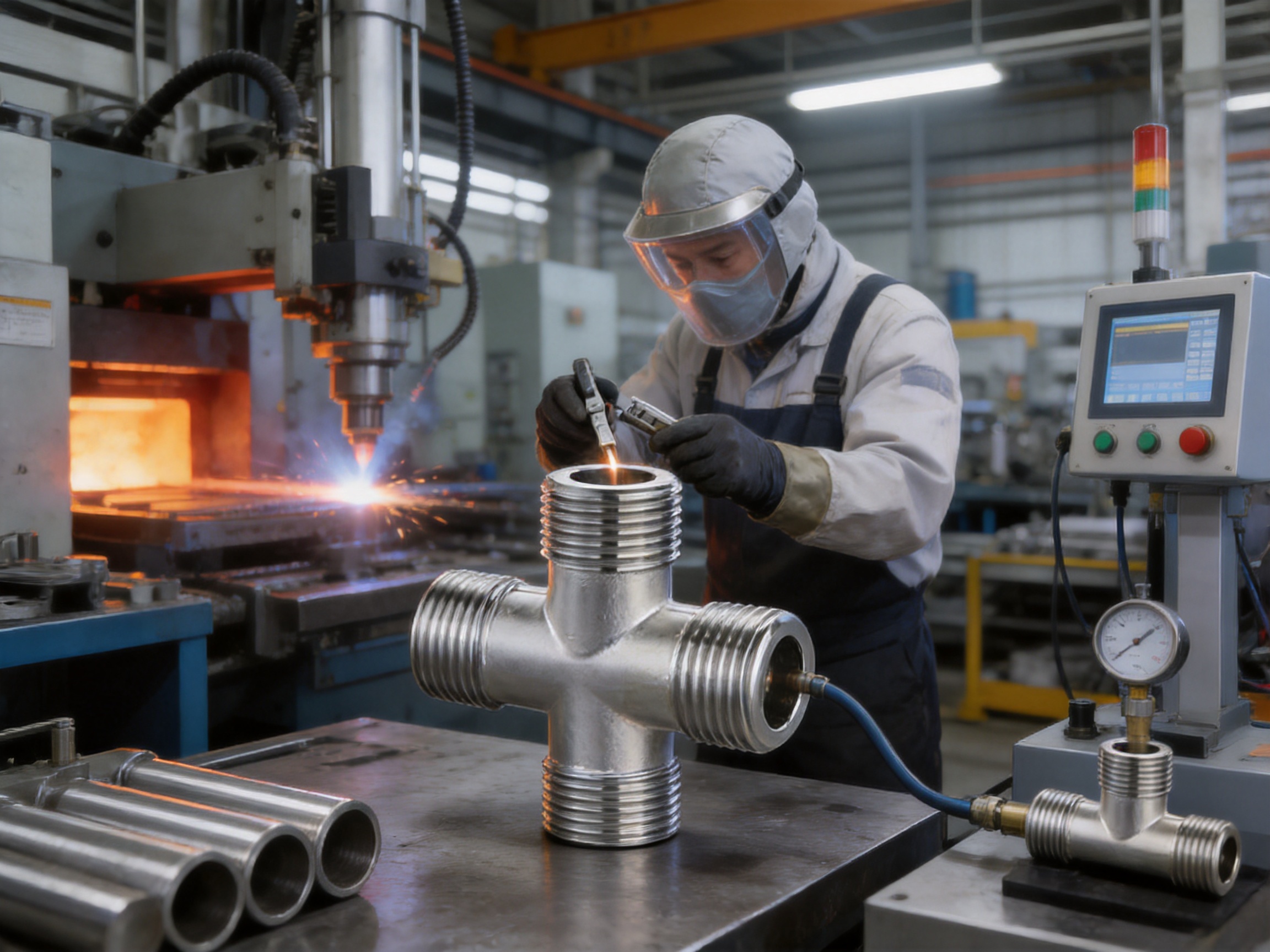
The facility includes 30 welding and forming production lines. Welding and forming are important operations for metal pipeline components because they influence geometry, joint strength, surface quality, and dimensional stability.
Forming processes create the basic tee configuration and help establish the shape of the branches and central body. Controlled forming can reduce irregularities and support repeatable dimensions. Welding, where applicable to the construction, must be carefully managed to achieve appropriate penetration, alignment, and surface condition.
Multiple production lines provide manufacturing flexibility. They may allow different product models, sizes, or production orders to be organized efficiently. They also support higher-volume supply while maintaining a structured workflow for inspection and process control.
Hydrogen Furnace Production Lines
The company also has two uninterrupted solid melting hydrogen furnace production lines. Furnace capability is significant because controlled melting and heat treatment influence the quality and consistency of metallic materials. A stable thermal process can help reduce unwanted variation in composition and physical properties.
Hydrogen furnace technology may be used in processes where a controlled atmosphere is important. The exact application depends on the material and product process, but controlled furnace operations can support cleaner production and more consistent results. For fittings used in gas systems, material stability and surface quality are important factors in long-term reliability.
Direct-Reading Material Analysis
The factory is equipped with a direct-reading spectrometer for metal material analysis. This type of equipment can assist in verifying the chemical composition of metal materials. Material analysis is valuable because the actual alloy composition affects corrosion resistance, strength, heat performance, weldability, and compatibility with the intended service.
Material verification is especially useful when customers require specific grades or when incoming raw materials must be checked before production. A controlled inspection process helps prevent unsuitable material from entering the manufacturing workflow.
Flow Tightness Testing
Flow tightness testers are used to evaluate whether a component or assembly meets required leakage-control expectations. For gas fittings, tightness is fundamental. A fitting that appears visually acceptable may still contain a microscopic leakage path caused by a defective weld, damaged thread, poor seal area, or manufacturing imperfection.
Testing provides an additional layer of assurance beyond visual inspection and dimensional measurement. Depending on the product and order requirements, customers may request information about test methods, pressure conditions, acceptance criteria, records, and sampling procedures.
Quality Management
The company strictly implements the ISO9000:2008 quality management system according to the supplied company information. A quality management system provides a framework for documented procedures, process responsibilities, inspection activities, corrective action, and continuous improvement.
Quality management is not limited to final inspection. It begins with order review and material purchasing, continues through production and testing, and extends to packaging, delivery, and customer service. This process-oriented approach is important for fittings because final product quality depends on many connected operations.
Certification and Industry Participation
The company holds a People’s Republic of China Special Equipment Manufacturing License for pressure pipelines and EU CE certification testing reports, according to the provided information. It is also a member of the China Urban Gas Association.
Certifications and industry participation can provide useful evidence of market experience and regulatory awareness. However, the specific certification scope should always be checked against the product model, size, application, and destination market. Buyers should request current documents when compliance is a contractual requirement.
Precision Features That Influence Performance
Thread Form and Surface Condition
The thread is the primary mechanical interface between the tee and its mating component. It should be clean, accurately formed, and free from dents, cross-threading, excessive burrs, or deformation. A smooth and consistent thread improves installation and helps the sealing method function correctly.
Installers should inspect both the external thread and the internal thread of the mating part before assembly. Dirt, metal chips, paint, or damage can prevent proper engagement. Threads should never be forced together when the pitch or standard is incompatible.
Branch Alignment
The three ports should be positioned accurately relative to one another. Poor alignment can make connected pipes difficult to install and may introduce bending stress. Accurate forming and controlled production help maintain the intended geometry of the fitting.
Alignment is also important when the tee is connected to a corrugated hose. Flexible hoses can accommodate some movement, but they should not be twisted or forced into an unsuitable angle to compensate for an incorrectly positioned fitting.
Sealing Areas
A threaded joint depends on the relationship between thread engagement, sealing surfaces, and the selected sealing material. The external thread tee should be used with a compatible sealing method approved for the gas service. Sealant should be applied carefully so that it does not enter and obstruct the internal passage.
Where a design uses a gasket, the gasket surface must be clean and properly aligned. Where thread sealant is specified, the installer should follow the sealant manufacturer’s instructions regarding compatibility, application amount, curing time, and pressure testing.
Structural Integrity
The tee body must withstand the loads created by internal pressure and connected components. The central junction is especially important because it combines multiple flow passages in one area. Sound material, appropriate wall thickness, stable forming, and properly controlled joining processes all contribute to structural reliability.
Applications
Residential Natural Gas Systems
In residential gas systems, a tee can distribute gas to multiple appliances. Typical installations may include cooking equipment, water heaters, heating appliances, or other approved gas-consuming devices. The fitting’s compact size can be useful in cabinets, service areas, and dedicated utility spaces.
Residential installations require careful attention to local regulations, ventilation, shutoff access, pressure testing, and professional installation. The tee should be selected according to the pipe or hose system and should not be installed in a way that hides an uninspectable or inaccessible connection.
Commercial Kitchens
Commercial kitchens often contain several gas appliances arranged within a limited area. A tee can support branch routing to cooking ranges, ovens, fryers, boilers, or other equipment. Stainless steel construction may be advantageous where humidity, cleaning chemicals, and frequent service activity are present.
Commercial systems commonly experience frequent changes in demand. The pipeline designer should verify that the complete network can deliver adequate flow without excessive pressure loss when multiple appliances operate simultaneously.
Industrial Gas Equipment
Industrial facilities may use gas for heating, drying, combustion, laboratory processes, production equipment, or test systems. In these environments, fittings may be exposed to vibration, elevated temperatures, dust, moisture, and intensive operating cycles.
The external thread tee can serve as a branch point near equipment or within a controlled distribution manifold. Its suitability depends on the gas type, pressure, temperature, chemical environment, and required certification. Industrial users should maintain clear documentation for every installed component.
Flexible Hose Assemblies
Because the product category includes stainless steel corrugated hose fittings for gas transmission, the tee can be used in assemblies that combine rigid pipework with flexible hose sections. Such assemblies are useful where equipment movement, vibration isolation, or installation flexibility is needed.
The hose must be selected with compatible end connections and an appropriate pressure and temperature rating. The fitting should not be used to create sharp bends, carry excessive weight, or support unsupported equipment. Correct routing and strain relief are essential for long-term performance.
Maintenance and Replacement Work
A threaded tee may also be used for repair, extension, or replacement work when an existing system has been isolated and assessed. Standardized model information helps maintenance teams identify the correct replacement more efficiently.
Before replacement, the line must be shut off, depressurized, purged where required, and verified safe. After installation, the complete system should be tested according to local regulations and the responsible engineer’s procedure.
Installation Guidance
Installation should be performed by qualified personnel familiar with gas piping requirements. The following points provide general guidance but do not replace applicable laws, codes, engineering instructions, or manufacturer documentation.
First, confirm that the tee specification matches the pipeline size and connection standard. The model reference RBG-IT15X15-GB/T 26002 and DN15 designation should be checked against the mating fitting, hose, valve, or pipe component.
Second, inspect the product before installation. Check for damaged threads, dents, contamination, cracks, corrosion, deformation, or blocked passages. Products that have been dropped or exposed to damaging conditions should be evaluated before use.
Third, clean the mating threads and verify compatibility. Do not combine thread systems merely because their nominal sizes appear similar. Differences in pitch, angle, taper, or standard can create a dangerous connection that seems to tighten but cannot seal reliably.
Fourth, use the appropriate sealing method. Apply sealant only where it is permitted and ensure that it is compatible with the gas, pressure, temperature, and fitting materials. Avoid excessive sealant and prevent it from entering the internal flow passage.
Fifth, tighten the connection using suitable tools and technique. Avoid gripping or twisting the corrugated hose itself. Excessive torque can damage threads, distort the fitting, or place stress on the pipeline. If a torque specification is available, it should be followed.
Sixth, support the connected pipework or hose assembly. The tee should not be used as a structural support for heavy equipment. Pipe supports should minimize vibration, movement, and bending loads at the connection.
Finally, perform the required tightness and pressure tests before commissioning. Gas should not be introduced into a new or modified system until the responsible professional has confirmed that the installation is safe and compliant.
Inspection and Maintenance
Routine inspection helps identify problems before they become serious. Inspection intervals should reflect the application, environment, operating pressure, local regulations, and manufacturer recommendations.
External inspection should look for corrosion, discoloration, mechanical damage, thread deterioration, moisture accumulation, unusual movement, and evidence of leakage. Any odor, hissing sound, visible frost, or unexplained pressure loss should be treated as a potential safety issue.
Connections should not be repeatedly tightened without determining the cause of a problem. Repeated adjustment may damage the threads or compromise the sealing surface. If leakage is suspected, the system should be isolated and assessed by qualified personnel.
In harsh environments, protective measures may be considered, provided they do not conceal inspection points or create moisture traps. The tee should remain accessible enough for testing, maintenance, and emergency isolation.
Purchasing and Technical Evaluation
When purchasing an external thread tee, buyers should evaluate more than price. A low initial cost may not represent the best value if the product has inconsistent threads, poor surface quality, inadequate documentation, or limited technical support.
Important purchasing questions include:
| Evaluation item | Why it matters | Questions to confirm |
| Model and nominal size | Ensures dimensional compatibility | Is the required product DN15 and does the model match the project specification? |
| Thread standard | Prevents incompatible connections | What thread form, pitch, and standard apply? |
| Material | Affects strength and corrosion resistance | What stainless steel grade or material specification is used? |
| Pressure rating | Determines safe service capability | What are the allowable working and test pressures? |
| Temperature rating | Supports safe operation near heat sources | What temperature range applies to the fitting and sealing system? |
| Leakage testing | Helps verify connection integrity | What tightness test method and acceptance criteria are used? |
| Quality documentation | Supports traceability and compliance | Are inspection reports, material records, or certificates available? |
| Application support | Reduces selection and installation errors | Can the supplier assist with system compatibility and customization? |
For larger projects, buyers may also evaluate production capacity, lead time, packaging, batch consistency, after-sales service, and the supplier’s ability to provide repeat orders. These factors can be more important than a small difference in unit price.
Why Manufacturing Depth Matters to Buyers
A supplier with manufacturing depth can offer advantages beyond the individual product. In gas pipeline projects, components must often work together. A company that produces metal hoses, natural gas pipelines, fittings, valves, and related hardware may better understand the connection requirements between these products.
Manufacturing equipment also influences responsiveness. Multiple welding and forming lines can support different order volumes and production schedules. In-house testing equipment can shorten feedback cycles when a dimensional or leakage issue is identified. Material analysis capability can help verify that raw materials meet the required composition before they are used.
Research and development capability is valuable when standard products do not fully meet a project’s needs. Customers may require a modified thread, different branch orientation, special surface treatment, alternative material, custom packaging, or a fitting designed for a particular hose assembly. Custom production should always be based on approved drawings, specifications, and validation procedures.
After-sales service is another important strength. Product selection, installation questions, replacement identification, and technical documentation can influence the total cost of ownership. A supplier that provides pre-sales and after-sales support can help customers reduce avoidable errors and maintain better system continuity.
Environmental and Operational Durability
Gas fittings are often expected to operate for many years. Durability depends on the interaction between material, design, manufacturing quality, installation, and maintenance. Corrosion-resistant construction can help extend service life, while accurate threads and strong junctions help maintain connection stability.
Environmental durability should be considered separately from pressure capability. A fitting may be mechanically suitable but still require protection in a highly corrosive atmosphere. Similarly, a fitting may tolerate the system pressure but be unsuitable for a location with excessive heat or chemical exposure.
Operational durability also depends on avoiding unnecessary mechanical stress. Vibration, repeated movement, unsupported hose weight, thermal expansion, and misalignment can gradually affect any connection. Good system design and proper installation are therefore essential partners to a high-quality fitting.
Safety Considerations
Gas is a safety-critical medium. The external thread tee should only be installed in systems designed and approved for the relevant gas service. The fitting must not be treated as a general-purpose connector without checking pressure, temperature, material compatibility, and regulatory requirements.
Do not install or modify gas piping while the line is pressurized. Use appropriate isolation, ventilation, purging, and testing procedures. Any suspected gas leak requires immediate attention by qualified personnel and may require emergency action under local safety rules.
Connections should remain accessible where regulations require inspection or shutoff. Concealed installations should be avoided unless specifically permitted and designed for that purpose. The completed system should be labeled and documented so that future maintenance personnel can identify the branch arrangement and isolation points.
Safety is strengthened when product quality, installation quality, and operating discipline are all addressed together. No single fitting can compensate for an improperly designed or poorly maintained gas system.
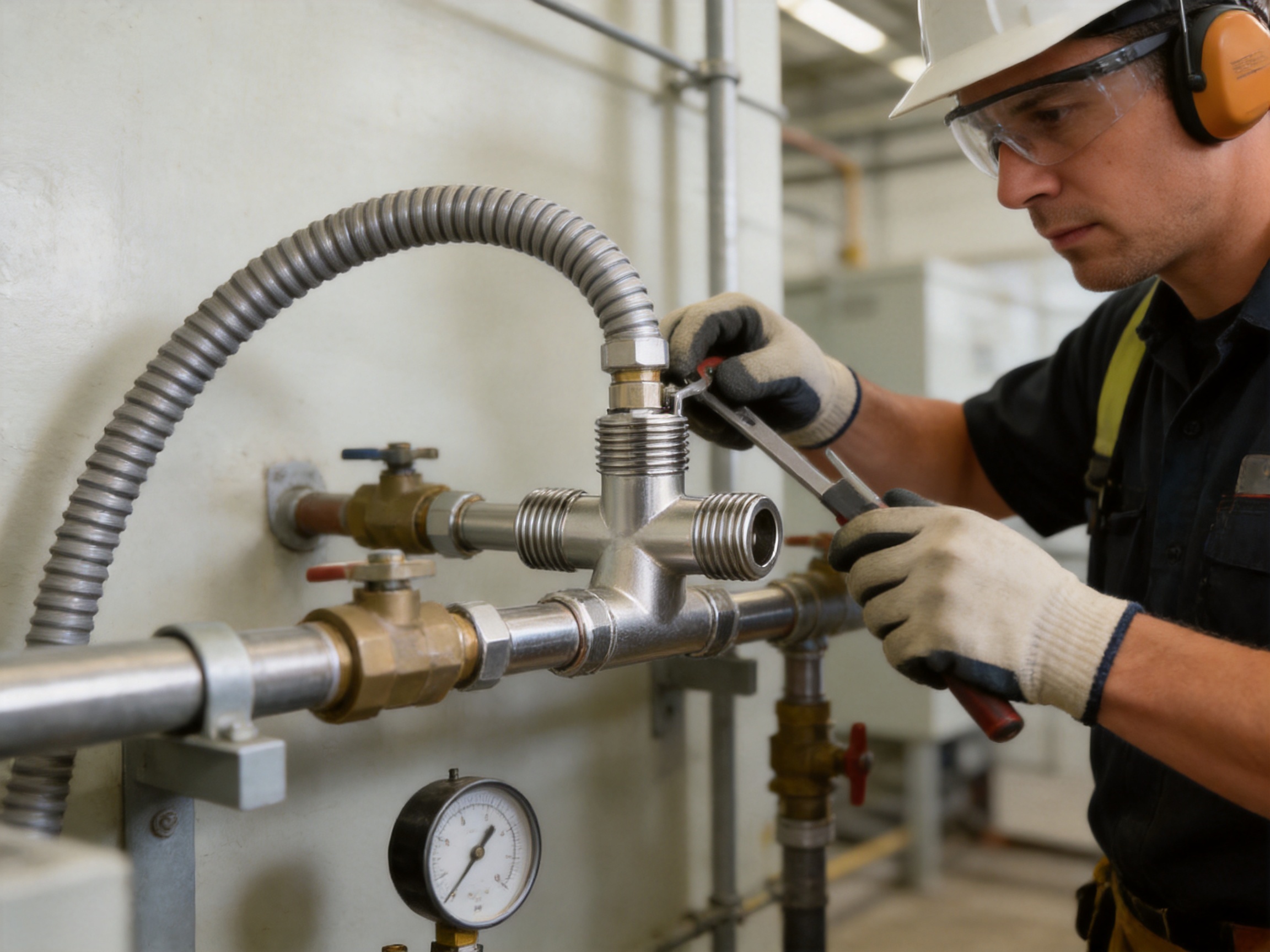
Quality Comparison with Generic Fittings
Generic fittings may appear similar in shape, but important differences can exist in material, thread precision, wall thickness, surface treatment, welding quality, inspection, and documentation. These differences may not be visible during a basic visual comparison.
A specialized external thread tee for gas transmission is developed with the needs of gas connections in mind. Its design emphasizes secure engagement, controlled flow branching, corrosion resistance, heat tolerance, and leakage prevention. A generic tee intended only for low-risk water service may not be suitable for gas, even if the nominal size is the same.
The most meaningful comparison should therefore be based on verified technical data. Buyers should compare pressure ratings, material grades, testing procedures, certifications, dimensional tolerances, and service support rather than relying only on appearance or purchase price.
The manufacturing resources associated with this product provide a further distinction. Welding and forming lines, hydrogen furnace production capability, direct-reading material analysis, flow tightness testing, quality management, and experience with energy equipment all support a more controlled production environment.
Recommended Use in System Design
The tee should be positioned where the branch connection can be inspected and maintained. The layout should minimize unnecessary stress and allow the connected pipes or hoses to approach the ports naturally. A branch should not be forced into alignment through excessive tightening.
Valves may be installed downstream of branch points when independent isolation is required. The designer should consider whether each branch needs its own shutoff, regulator, filter, or pressure monitoring device. The tee itself divides flow but does not automatically provide branch isolation or flow control.
Where flow demand is uneven, the branch arrangement should be reviewed to ensure that the system delivers adequate pressure to each endpoint. The central passage and branch geometry are only one part of hydraulic performance; pipe length, internal diameter, gas properties, regulators, and appliance requirements also affect the result.
For hose applications, the tee should be combined with hoses that have compatible connection dimensions and ratings. Hoses should be routed with appropriate bend radii and should be protected from abrasion, sharp edges, excessive heat, and chemical exposure.
Product Identification
Correct identification helps prevent ordering and installation errors. The supplied product information is summarized below.
| Product category | Stainless steel corrugated hose fittings for gas transmission |
| Product name | External Thread Tee |
| Product number | ZLP-018 |
| Model number | RBG-IT15X15-GB/T 26002 |
| Specification | DN15 |
| Primary function | Branching and splitting gas flows |
| Connection type | External threaded connection |
| Typical application | Residential and industrial gas pipeline systems |
Before ordering, customers should confirm whether the required quantity, thread orientation, material grade, finish, packaging, and documentation correspond to the project. For international shipments, destination-country requirements should also be reviewed.
Q&A
What is the primary purpose of the external thread tee?
Its primary purpose is to create a branch in a gas pipeline. It allows one gas line to connect with two branch lines, or it can combine two branch flows into one line when the system is designed for that arrangement.
What does DN15 mean?
DN15 is a nominal diameter designation. It is used to identify the approximate size category of the fitting and does not by itself define every outside dimension, thread detail, or pressure rating. Compatibility must be confirmed using the complete technical specification.
Can the tee be used with any DN15 fitting?
No. Nominal size does not guarantee compatibility. The thread standard, pitch, connection form, material, pressure rating, and sealing method must all be compatible. The mating component should be verified before installation.
Why are external threads useful?
External threads provide mechanical engagement with an internally threaded component. They allow the tee to be connected to compatible valves, adapters, hose ends, and other fittings while maintaining a compact pipeline arrangement.
Is the product suitable for both residential and industrial systems?
The product is described for use in residential and industrial gas systems. Actual suitability depends on the gas type, pressure, temperature, installation environment, local regulations, and the technical rating of the complete assembly.
What makes stainless steel useful for this application?
Stainless steel can provide corrosion resistance, heat resistance, strength, and long-term durability. The exact performance depends on the stainless steel grade and the service environment, so material documentation should be requested when a specific grade is required.
Does the tee control gas pressure?
No. The tee divides or combines flow but does not independently regulate pressure. Pressure control requires suitable regulators, valves, or other system components selected by the pipeline designer.
Can the tee support a hose or appliance?
The tee should not be used as a structural support for heavy equipment or unsupported hose weight. Connected pipework and hoses must be properly supported so that bending, vibration, and pulling forces are not transferred into the threaded connection.
How should a threaded connection be sealed?
The sealing method depends on the thread design and system requirements. A compatible gas-rated sealant, gasket, or approved sealing method should be used according to the manufacturer’s instructions and applicable regulations. Excessive sealant should be avoided.
What manufacturing equipment supports product quality?
The company operates 30 welding and forming production lines, two uninterrupted solid melting hydrogen furnace production lines, a direct-reading metal material analysis spectrometer, and flow tightness testing equipment. These resources support material verification, controlled production, and leakage-related inspection.
Can customized products be requested?
The company provides custom production of metal hoses, corrugated hoses, pipe fittings, and related precision-engineered products. Customized tee requirements should be evaluated using approved drawings, material specifications, thread details, performance ratings, and testing requirements.
What should be checked after installation?
The installer should verify alignment, thread engagement, sealing, support, accessibility, and the absence of leakage. The completed system must undergo the pressure or tightness tests required by the applicable code and responsible professional.
How can customers confirm compliance?
Customers should request current technical documents, material information, inspection records, certification details, and product-specific evidence where required. Certification scope should be checked carefully because a general company certificate may not automatically cover every product or application.
Conclusion
The external thread tee is a compact but important component for gas pipeline branching. Its three-way structure simplifies the division of gas flow, while the external threaded configuration provides a practical and stable connection with compatible internally threaded components. Corrosion-resistant and heat-resistant construction supports use in demanding environments, and the fitting can serve residential, commercial, industrial, and flexible hose applications when properly selected.
Its advantages over less specialized alternatives include reduced joint complexity, dependable mechanical engagement, installation flexibility, serviceability, and the potential for long-term material durability. These benefits are strengthened when the fitting is produced through controlled forming, welding, material analysis, tightness testing, and documented quality management.
The manufacturer’s integrated experience in metal hoses, natural gas pipelines, pipe fittings, valves, and related energy equipment provides a broad foundation for product development and customer support. Its production resources, including multiple welding and forming lines, hydrogen furnace production lines, material analysis equipment, and flow tightness testers, demonstrate the importance placed on manufacturing capability and quality control.
For the best results, buyers and installers should verify the thread standard, nominal size, material, pressure rating, temperature range, gas compatibility, certification requirements, and sealing method before use. When these factors are properly addressed, the external thread tee can contribute to a safer, cleaner, and more efficient gas distribution system.
References
1. GB/T 26002, applicable requirements for gas pipeline fittings and related connection components.
2. ISO 9000 series, quality management systems and fundamental quality management principles.
3. General engineering guidance for threaded pipe connections used in gas transmission and distribution systems.
4. General manufacturer guidance for stainless steel corrugated hoses and gas pipeline fittings.
5. Applicable national and regional codes for the design, installation, pressure testing, and maintenance of gas piping systems.
6. General material engineering references concerning stainless steel corrosion resistance, heat performance, forming, welding, and chemical composition verification.